Author Archives: nope2BC

Unknown's avatar

About nope2BC

Check out my blog: Saying NOPE to Breast Cancer

They’re back – second expansion

WARNING: NSFW / graphic content below.

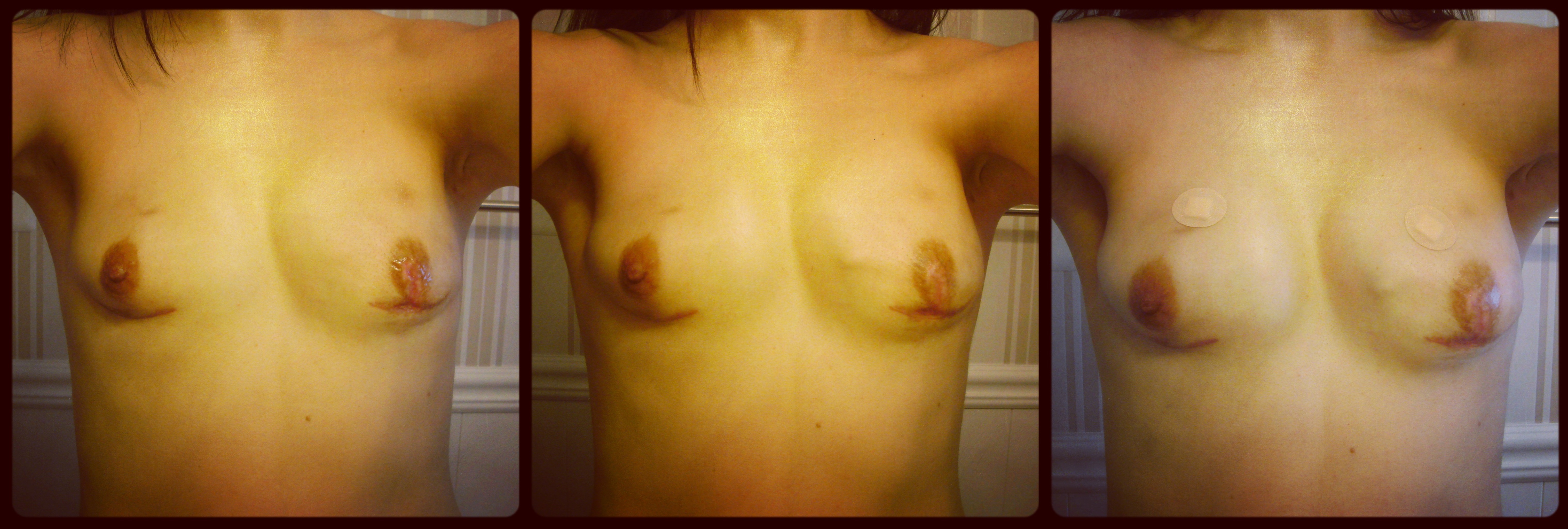
Another expansion done! We added 75ccs to each expander, for a total of 225ccs/side (pic below). I am now just a tad over my size before the prophylactic bilateral mastectomy in January.

I decided to speed things up a little bit – rather than doing 50ccs per expansion, we bumped it up to 75ccs. So far, so good, but it has only been a few hours. The worse of the pain the first time hit me when I woke up on the day after the fill. I felt like I was back in the recliner the first week post-op. I popped an ibuprofen, did some stretching, and moved on with my day. The pressure eased as days passed and I was back to “normal” within a week. Well, here we go again. I imagine it will get worse with each fill, but we shall see.

Breast Reconstruction Guidebook Figure 7.1For a recap of why/how the expansion process works, see They’re growing or check out the video below, which was shared by fellow PBM-er Trisha on her blog I’m getting my boobs chopped off. By the way, if you haven’t noticed, I list a number of blogs on the right side of the page under Relevant Sites & Blogs. Check them out! Most of those ladies has also undergone a mastectomy; some proactively and some after a breast cancer diagnosis.

fills-2013_4_12

100 + 50 + 75 = 225ccs

Source of Figure 7.1: Steligo, Kathy. Breast Reconstruction Guidebook: Issues and Answers from Research to Recovery. Maryland: The Johns Hopkins University Press, 2012. Print, third edition.

Breast cancer and diet, continued

As I mentioned in a previous post, Breast cancer and diet, I subscribe to the daily video from Dr. Greger (NutritionFacts.org). This week, he posted a series of videos about fiber, flaxseeds, and breast cancer. I just can’t keep these to myself!

A clinical study explored lignans/flaxseeds and thier effect on tumor growth (comparing it to Tamoxifen). Consuming flaxseed muffins over a period of five weeks made tumor cell proliferation go down, cancer cell death go up, and HER2 score go down. That’s amazing. The little ol’ ground flaxseeds I put in my morning oatmeal can do this!

Similar positive effects are linked to fiber. A study out of Yale on pre-menopausal women concluded that a higher intake of soluble fiber was associated with a significantly reduced risk of breast cancer – 62% lower odds. For younger women that goes up to 85%. Whether it’s the fiber directly or the way it interacts with other nutrients in your body, it doesn’t hurt!

Check out the short videos below to learn more.


Flaxseeds & Breast Cancer Survival: Clinical Evidence

Flaxseeds & Breast Cancer Survival: Epidemiological Evidence

Flaxseeds & Breast Cancer Prevention

Fiber vs. Breast Cancer

They’re growing – first expansion

WARNING: NSFW / graphic content below.

Goodbye ugly scab, hello first fill!

The scab that has been living on my left boob has finally fallen off! Can I get a “woo hoo”? It has been two full months since my prophylactic mastectomy on January 22 and the start of my adventure with resulting skin/nipple necrosis. Today I had my first fill. 50ccs of saline were injected into each tissue expander, bringing the total to 150ccs/side.

Tissue expanderWhat are tissue expanders, you ask? The type of breast reconstruction I chose is two-staged: tissue expanders first, followed by silicone breast implants. The tissue expanders, which were implanted underneath my pectoralis major muscle during the mastectomy, get filled with saline on a regular basis to stretch said muscle and the skin that covers it, until the desired volume is reached. They are like “pre-implants.” Similar shape, but more rigid, unnatural, and uncomfortable. They have a round magnetic port in the top half, which allows for insertion of a needle, without compromising the expander.

Breast Reconstruction Guidebook Figure 7.1

The process of filling the tissue expanders is pretty quick and uneventful. First the nurse uses a little plastic contraption with a metal pin at the end to find the magnetic port in the tissue expander. Once the center of the port is identified, the nurse sanitizes the area and injects the needle attached to a syringe holding the saline. She then slowly pushes the plunger until all 50ccs of fluid have been injected into the expander. This takes less than one minute. After completing the fill, she places a little round band-aid over the injection site. Same story on the other side.

This procedure is overall painless (based on just the first fill). The only sensation was a brief sting as the needle was inserted into the port through the skin.Three hours later, I feel a little bit of that now-familiar pressure on the muscle and skin stretched over the expanders. As soon as I got home, I popped an ibuprofen, did some stretches, and smeared my chest with Palmer’s cocoa butter oil.

As I look down at my chest, I can see that my foobs are bigger. It is a small difference, but it’s there. It will be interesting to watch these things grow. I can already tell that it won’t be pretty. The expanders didn’t settle exactly the same way: one sits higher and the other one is a bit twisted. The asymmetry seems to be normal based on my plastic surgeon’s feedback and the photos other women have shared. Enjoy the visual!

Fills 2013_3_29

100 + 50 = 150ccs

The fills will continue every two weeks at 50ccs/side. At this point, I have not yet decided how big I want to go (one of my friends joked: “go big or go home!”). However, I did find out that my breast surgeon removed 184 grams of breast tissue/side, which translates to roughly 184ccs, so one more fill and I will be back to pre-op size. Next appointment: April 12.

Source of Figure 7.1: Steligo, Kathy. Breast Reconstruction Guidebook: Issues and Answers from Research to Recovery. Maryland: The Johns Hopkins University Press, 2012. Print, third edition.

Back to work

So it has been over six weeks since my prophylactic mastectomy and I feel great. My recovery has gone relatively smoothly and I am enjoying the return of full range of motion, exercising, lifting the kitties, scratching the middle of my back, vacuuming (maybe “enjoying” is a bit too strong of a word for this one), and I’m finally back to work.

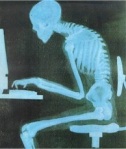
slouchingI have a desk job, so it isn’t very physically demanding, but I did feel completely pooped after my second day back. Sitting in one spot for most of eight hours is much different than lounging on the couch and it caught up with me. I find that the tightness across my chest, while not painful, is uncomfortable, so my shoulders droop to relieve the pressure and I slouch. Although I’m more comfortable that way, it makes my whole body ache at the end of the day. It’s just awkward. I must admit that I was getting kind of bored at home, though, so the return to work was good for me. I missed the face-to-face interaction with my friends and co-workers.

heartsOn the healing end of things: I still have a scab on lefty (about the size of a dime). Expander fills have been delayed until all is well and the scab falls off on its own. My next appointment with the plastic surgeon is scheduled for March 29th, so I am hoping healing will be complete by then and we can begin the expansion process.

Not much else going on in post-mastectomy land.

One month later

It has been one month since my prophylactic nipple-sparing bilateral mastectomy. How am I doing? Here’s an update:

  • Mario kartI am now driving and no longer need a chauffeur.
  • Sneezing still hurts.
  • Got clearance to resume aerobic exercise, but no running or jumping.
  • Planning on going back to work in less than two weeks. Eek!
  • I am not a fan of these expanders. They are hard as rocks.
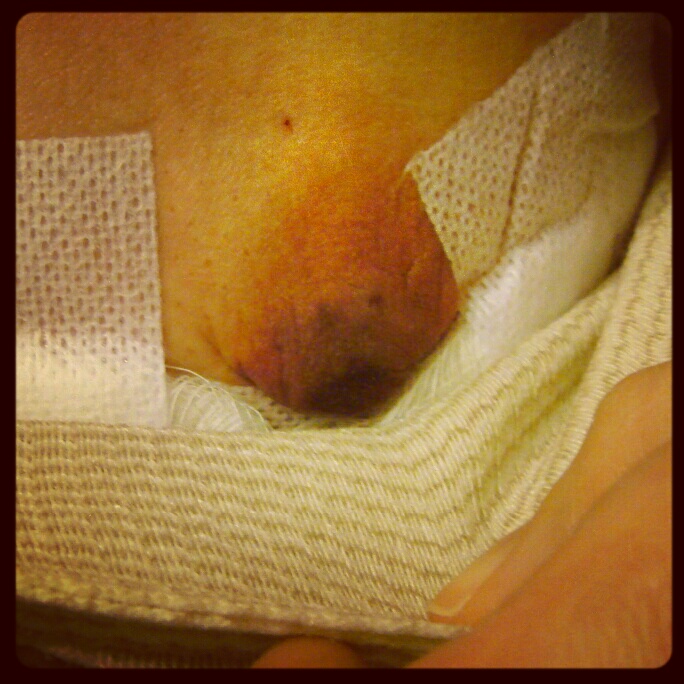
  • Still no expansions/fills. We are waiting for the necrotic area to heal. The large scab is slowly lifting at the edges. I trim it so it doesn’t get caught on clothes.
  • Had the 14th and last hyperbaric treatment today. Not sure how much of the healing can be attributed to the treatments, though. The wound has definitely gotten better, not worse, so it didn’t hurt. My breast surgeon believes that it saved Dusky!
  • Some bruising has developed on my right side, right over the fill port, so I stopped massaging the skin and expanders. Still using the cocoa butter oil with vitamin E.
  • Making progress in getting back full range of motion. I am happy to report a small victory – I can now bring my arms all the way to the floor during the floor/towel exercise at 13:10 in this post-op exercise video. Big accomplishment!Coins
  • Haven’t gotten any bills yet, but I know they’ll be pouring in soon.

Overall my recovery has been going great! The complications I’ve had are relatively minor and I am happy that it has not been worse.

FORCE: Update on ovarian cancer prevention research

facingourrisk's avatarThoughts from FORCE

In 2008 FORCE conducted a survey to learn about research priorities for the HBOC community. We learned that women want better methods for ovarian cancer detection and prevention for ourselves, our children, and future generations. For this reason, we have worked closely with researchers exploring new options and we have carefully followed and shared with our community the progress in ovarian cancer detection and prevention.

Since BRCA testing became available, experts have recommended bilateral salpingo-oophorectomy or BSO (removal of the ovaries and fallopian tubes) for women with mutations between the ages of 35 – 40 or after childbearing is completed. Until large studies on women with mutations were completed, there was little data and only common sense to back up this recommendation. Later, research proved that for women with BRCA mutations removing the ovaries and tubes lowers the risk of developing and dying from breast cancer and ovarian cancer. I recall…

View original post 854 more words

Hyperbaric oxygen therapy

WARNING: NSFW / graphic content below.

Tissue or skin necrosis is one of the risks associated with a mastectomy (or any surgery), which is typically a result of loss/interruption of blood vessels feeding the tissue. Read more about it in my previous post: Tissue necrosis.

Hyperbaric oxygen therapy, most commonly known to treat decompression sickness related to deep diving, is sometimes used for treatment of wounds or necrosis. I was not familiar with this type of treatment before entering this community and even now, being completely engrossed in it, I don’t see it mentioned often.

In a nutshell

Hyperbaric chamberHyperbaric oxygen therapy (HBOT) involves the breathing of pure oxygen while in a sealed chamber that has been pressurized at 1-1/2 to 3 times normal atmospheric pressure. – American Cancer Society

What that means is: you get into a clear plastic tube that is sealed, the air pressure is raised (while your ears constantly “pop”), pure oxygen is pumped into the tube, and you get to watch two hours of TV while the oxygen works its magic. I renewed my Netflix subscription just for the occasion!

Why do it?

The main benefit to hyperbaric oxygen therapy for wounds is esentially faster healing. Here are some key points from WoldWideWounds.com:

  • Oxygen used under pressure can assist wound healing
  • It can be used successfully in wounds such as failing flaps and necrotising soft tissue
  • HBO therapy provides oxygen needed to stimulate and support wound healing where there may be insufficient supply
  • It combats clinical infection
  • It is a relatively safe non-invasive therapy

Does it work?

I had 14 treatments total and can definitely see changes in the necrotic area. I am unsure, however, how much of it can be attributed to the hyperbaric oxygen therapy versus regular rate of healing, diet, exercise, etc. Both my plastic surgeon and the wound care doctor agree that I will still have scarring and “discoloration” of the tissue underneath the necrotic skin, but will not need any skin grafting or other forms of treatment. My breast surgeon thinks that HBOT saved my nipple. So discoloration I can deal with, as long as I can avoid additional surgery and get to keep Dusky, the rebel left nipple!

These are earlier pics of changes in the wound over the first two weeks post-op, pre-HBOT:

Necrosis progress

This is what Dusky looked like after ten HBO treatments and four weeks post prophylactic bilateral mastectomy:

Necrosis four weeks

This is after the scab fell off two months post-op. Unfortunately, I did lose the tip of my nipple. Yup, just the tip. It took another couple of months for the pigment to return.

2013_7_12 Pigment

Recovery photos

I have finally added some photos! Check out the MY PHOTOS page.

CameraA couple of days before my prophylactic nipple-sparing bilateral mastectomy I took a “before” photo of the girls. Since then, I have been taking daily pictures to document my journey. Take a peek to see how I’ve been doing during my recovery thus far. The pics are of my nude torso, so NSFW/graphic.

Calling for bra donations!

Free the GirlsDo you have some old, no-longer-needed, gently-used bras? Want to provide job opportunities to women rescued from sex trafficking? Free the Girls!

I just read a moving story on CNN about a US non-profit charity, Free the Girls, that helps former sex slaves earn a living by selling donated bras!

By partnering with safe houses and after-care facilities, we provide an opportunity for women rescued from sex trafficking to earn a living selling second-hand clothing while going to school, getting healthy, and caring for their families. – Free the Girls

17 bras donated

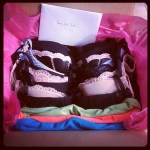
My donation

I just had to share this. I was thinking about having a bra-burning party, because I will never wear any of my bras again, but this is so much better!!! I was excited to get upstairs and look through my stuff! Can you help too? Check out the Free the Girls website for more info, drop-off locations, the shipping address, and more.

Here’s a link to the story on CNN: Bras offer lifeline to rescued slaves.

Tissue necrosis

WARNING: NSFW / graphic content below.

What is necrosis?

One of the risks associated with a mastectomy, or any surgery, is tissue necrosis. This occurs when the blood supply is compromised and the cells aren’t receiving enough oxygen; the skin begins to die. As this happens, it turns black and hardens into a scab. Although the dead tissue can be removed (debridement), it cannot be brought back to life. Hyperbaric oxygen therapy (HBOT) can be used to treat surrounding tissue – more on this in another post: Hyperbaric oxygen therapy.

Breast skin is fragile after mastectomy. If it’s exceptionally thin after the breast tissue is cut away or is handled too roughly, it may die. The same result may occur if the breast surgeon severs too many blood vessels that feed the skin or uses eletrocautery too aggressively and burns the inside of the skin, which may then blister and die.
– Steligo, Kathy. Breast Reconstruction Guidebook: Issues and Answers from Research to Recovery. Maryland: The Johns Hopkins University Press, 2012. Print, third edition.

My case

Nipple necrosis was one of my big worries when I was struggling to decide whether my prophylactic bilateral mastectomy was going to be nipple-sparing. I did a lot of research and talked to both of my surgeons about it. Check out my earlier posts on the topic: Nipples, pecs,bras, OH MY! and Let’s give them a chance.

Left nipple day of PBM

Left nipple day of PBM

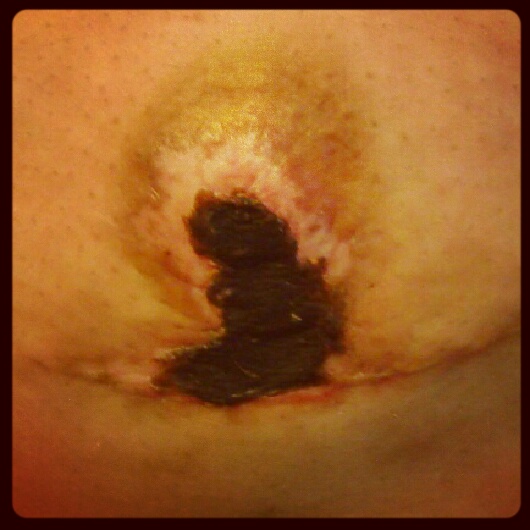
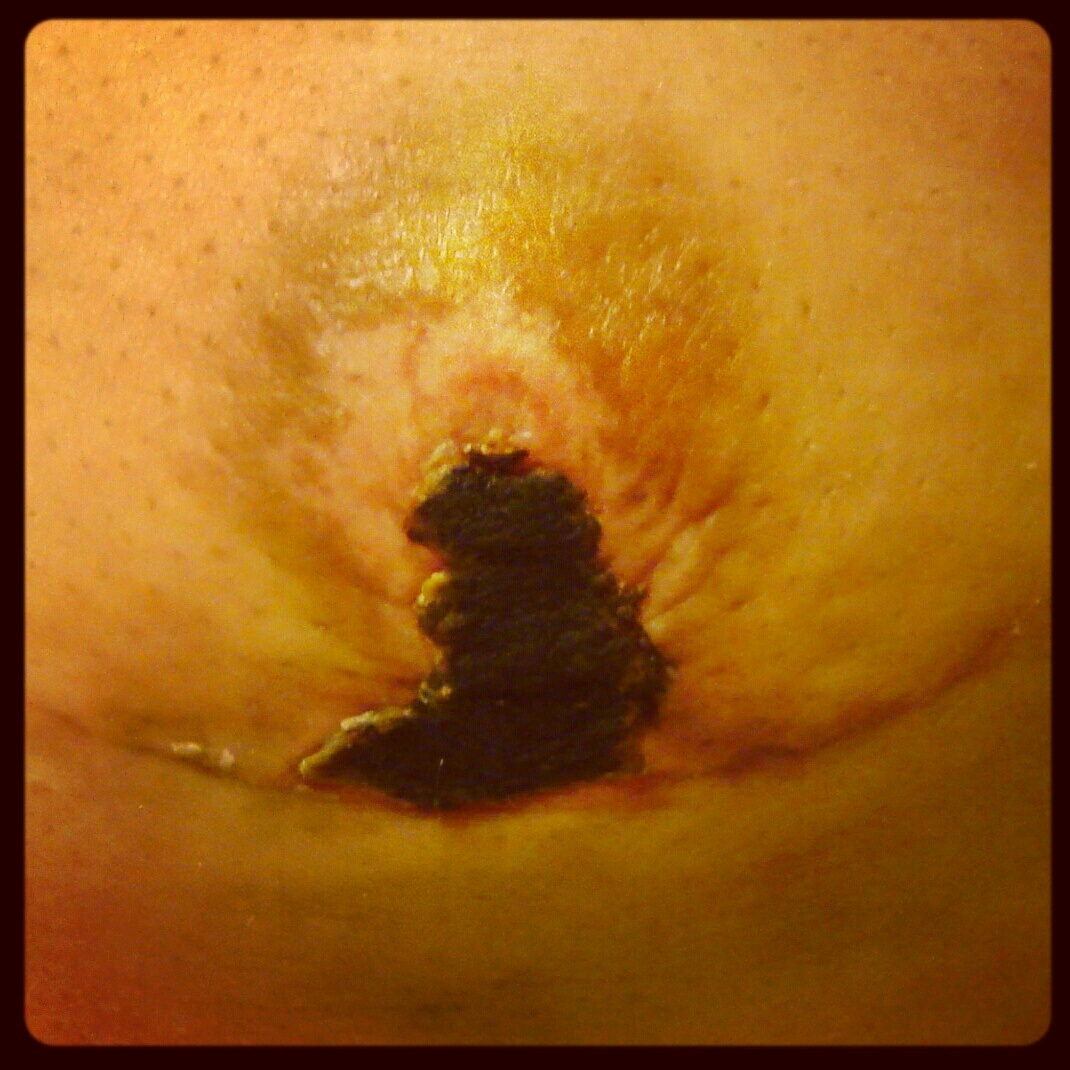
I had the unfortunate chance to experience necrosis in the area of the left nipple and skin directly underneath it. The day of my surgery, we could already see that there may be a problem. The left nipple looked “dusky.” On day six, the sterile strips covering the bottom of the nip and the incision underneath it were removed and we discovered a bit of a mess there as well. In the next 24 hours, the area turned black. A little panicked, I reached out to my PS for his guidance. I was told to just sit tight, because there really isn’t anything that could be done. I washed the area with anti-bac soap and kept an eye on it.

Over the coming days, the small area of necrosis changed shape a bit, but did not get better. Check out the images below, which show the changes over a two-week period. The day I wrote this post, 18 days after PBM, some of the scabs on the nipple have fallen off, revealing bright pink skin underneath. The larger area of necrosis under the nipple is still covered with a tough, black scab. I have had four hyperbaric oxygen treatments in an effort to minimize the damage. More on that here: Hyperbaric oxygen therapy.

I am told that my nipple will be fine. Worst case scenario = scarring or discoloration in the area below the nipple as the scabs fall off. We shall see. I will post an update when that occurs.

Necrosis progress

2/22: Scab is slowly lifting up.

Necrosis one month

7/12: Scab is long gone and the pigment has returned.

2013_7_12 Pigment