Tag Archives: health

Boobfographic

For all those Ladies that still have their boobies, here’s a fun boobfographic (I came across on good ol’ Imgur; originally posted by R.O.I Media) demonstrating ways to check the girls:

Breast Cancer is treatable if it’s detected early on. This means that if you, or you and your partner, examine your breasts regularly for warning signs, you stand a better chance of finding lumps before it’s too late.

Tip #1

The soap you use in the shower allows your fingers to glide along the surface of the skin, making it easier to feel irregularities in the texture of the breast tissue.

Tip #2

Checking your partner’s breasts – or your own – isn’t all about intimate fondling; you have to stay focused. Gently massage with varying levels of force to ensure that the area is thoroughly examined.

Tip #3

Remember that it’s not just the soft breast tissue that needs to be checked, but the whole chestal area – from collar bone to armpit to upper ribcage.

It doesn’t matter whether your cup is half full or if it runneth over – it’s essential to take a hands-on approach to your boobal well-being. Use these three easy steps when examining your breasts and consult your doctor for further information. See more at R.O.I Media.


BTW, today is my one year blogaversary. Woo hoo! A year ago I wrote my first post: You’re doing WHAT? What a difference a year makes!!!

Pre-op prep

The awesome Casey Eischen, who is not only a fitness and nutrition expert certified in working with women after breast cancer related surgery or treatment, but also had a prophylactic mastectomy herself in November ’12, has recorded another great video. This one is all about pre-op preparation – how to set yourself up for a successful recovery following breast cancer related surgery. Watch this 8.5 minute webisode for some great tips and tricks to prep for surgery!

Also check out my own preparing for surgery checklist.

Attitude is everything

Attitude

Yes, THIS. I have hit a  pretty huge speed bump on my road to being finished. A major setback that’ll add at least three more months to this process. When I had my prophylactic bilateral mastectomy in January, I expected to be finished by mid-summer. HA! It’s almost January again! Yes, I’m devastated and angry, but there really isn’t anything I can do about it now except focus on recovery and what’s ahead of me.

Attitude really is everything. While you cannot always control what happens to you or around you, you have complete control over your reaction to it. I have chosen to continue to be positive, because the alternative won’t help anyone or improve my situation.

Good news x 3

I saw Dr. M for a follow up on Friday.

  1. The Lone Drainger is out! Whoop whoop! I was producing less than 15 mL/day.
  2. Culture results are good and show no signs of infection. This doesn’t mean I didn’t have one, it means that the antibiotics I have been on since Monday are working.
  3. TESSAI might not have to have a tissue expander!!! Dr. M thinks the tissue won’t retract so much that I would have to start all over. If all looks good in a few months, he will place the implant via a small hole in my armpit using the TESSA technique (Transaxillary Endoscopic Subpectoral Smooth Augmentation). This was the best news! It also means that we will NOT have to mess with the incision/scar again.

Houston, we have a problem

WARNING: NSFW / graphic content below.

Before I tell you about what has been happening for the last few days, I just want to say to those that are considering this procedure, preparing for one, or have already started the process: women who undergo a mastectomy, whether prophylactic or not, don’t always experience complications. Actually, I’d say that most do not, based on my involvement in a few online support groups and interaction with women in my local community. Everybody’s experience is different, because of different doctors, hospitals, body condition, other health issues, activities during recovery, nutrition, etc. There are many factors. Each person should consider their scenario and discuss concerns they may have with their surgical team.

Another thing to keep in mind is that usually the people that have problems are the ones that speak up. You know – the squeaky wheel thing. There are so many women out there that have had a completely complication-free experience and have beautiful results! You can’t tell that they’ve gone through this journey unless they tell you! Those women usually don’t linger in the support groups, stop blogging about it, move on, and just leave it all behind them. They are DONE and don’t have to think about it again.

Okay, Houston, we’ve had a problem here

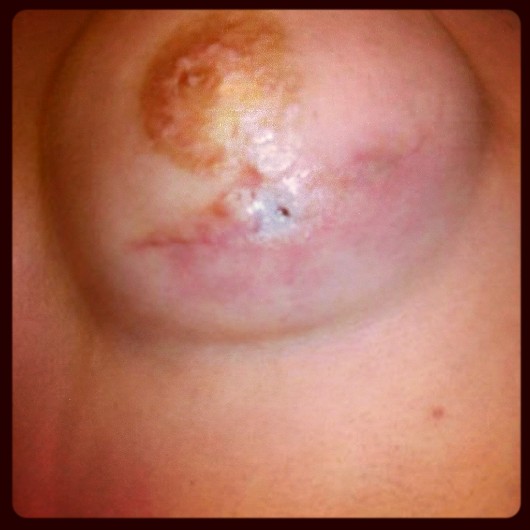
Unfortunately, I’m not one of them. Upon my return from vacation, I started working out again (cardio) and I also began using Kelocote on my hypertrophic scars, as I mentioned in a recent post. Both of these activities began on Sunday. The following Wednesday I saw Dr. M and things looked good. The next day I noticed a bit of redness around the incision on my left breast. By Saturday there was a small area in the center of the scar tissue from my bout with necrosis that had turned blue. I emailed Dr. M and got this response:

Yes, this is a significant problem. Need to see you tomorrow.
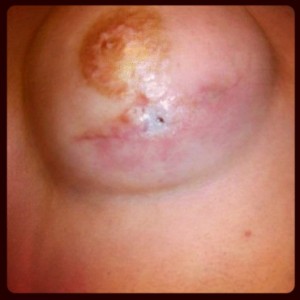
HoleBy Monday afternoon, I had a hole. By early evening I had chills, sweats, and a fever of 101.7. Panicked, I called the after-hours service to page Dr. M and he called back immediately. The plan was to continue on the antibiotics, take a couple Tylenol, and sit tight unless the temperature spiked past 103, at which point I’d hightail it to the ER. Within two hours the temperature dropped below 100, but I knew what was coming: the implant had to go.

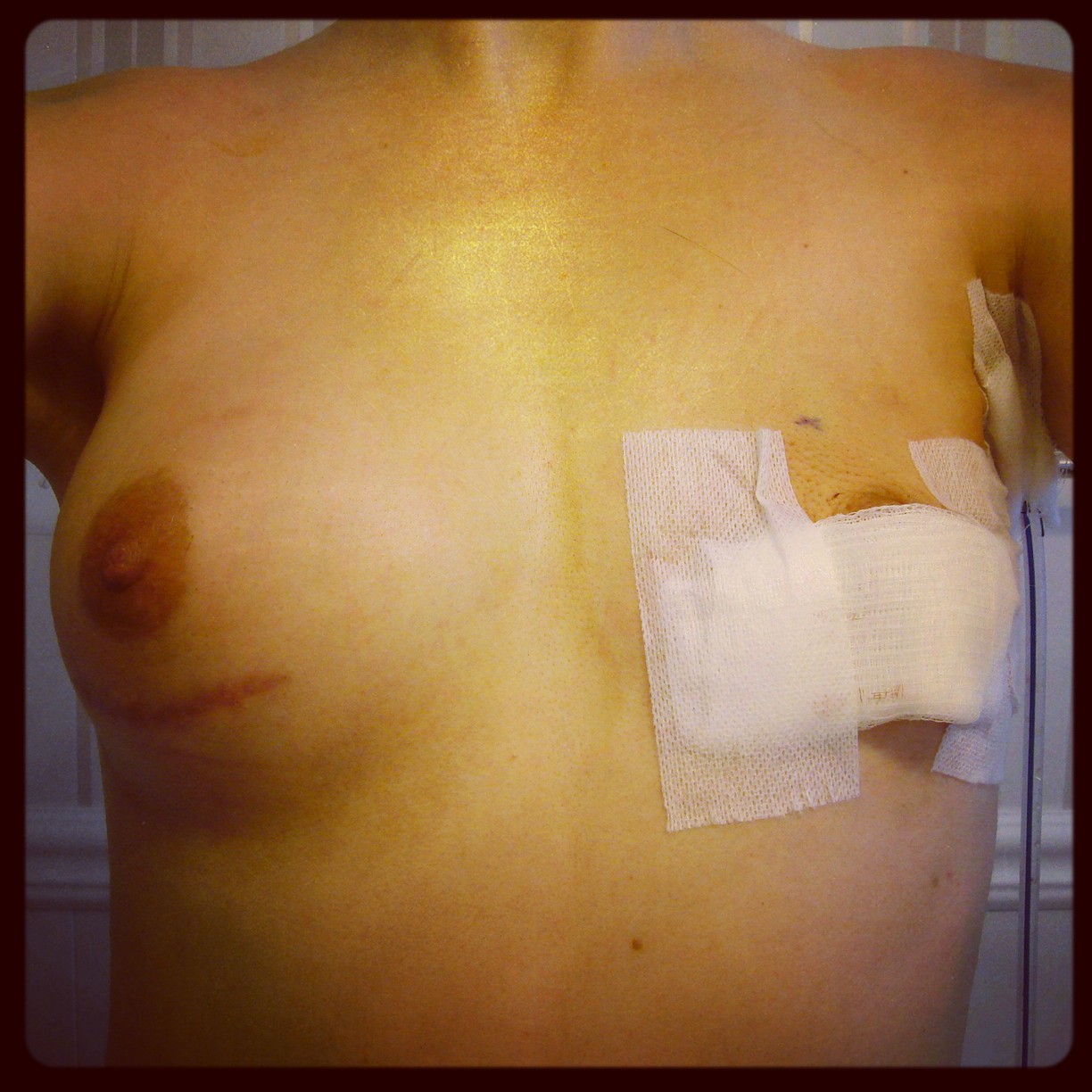
My surgery was at 5pm on Tuesday, October 15. Dr. M cleaned up the incision and removed the implant. I am left with one breast and another drain! I really REALLY don’t like drains, but who does? What’s next? We have to let everything heal for at least three months before we being talking about restarting reconstruction on that side. I’m am so bummed by this humongous setback!

Why did this happen?

A combination of things may have caused this, but it’s hard to say exactly which was the straw. In Dr. M’s experience, implants are usually (but rarely) lost due to complications from three major things: radiation, smoking, and/or trauma. I fall into the third category. The necrosis I experienced in January produced a lot of scar tissue, which has poor circulation. My use of Kelocote on that scar tissue introduced chemicals into the equation. On top of that, I started working out again. My body protested against the combination of old and new trauma. So here I am, uniboobin’ it for at least three more months! Good thing it’ll be during winter and I can camouflage things a bit. I present a foob and a drain:
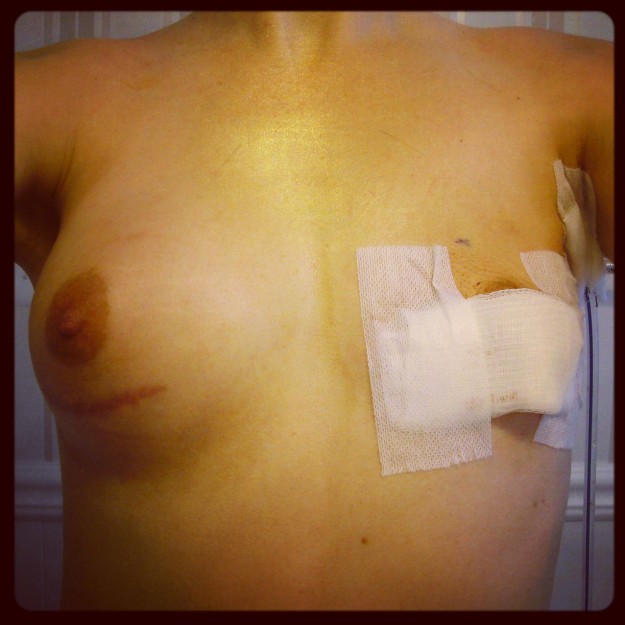
2013_10_16 closeup

Team FORCE at the local Race for the Cure

Team FORCE

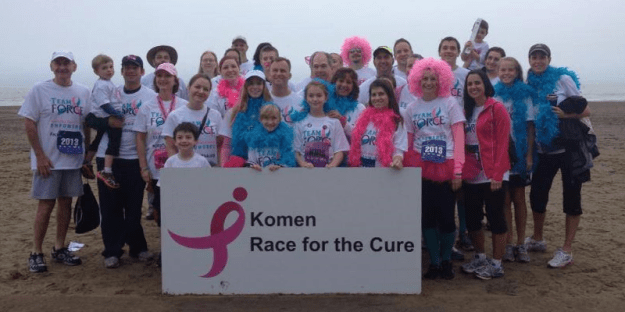
There we are: Team FORCE at our local Susan G. Komen Race for the Cure. We had a great time, even though the weather was not cooperating. We made a lot of new contacts in our local community, both of the vendor/organization type and the individual type. We met some really great people that may benefit from our support and us from theirs! Looking forward to more events as part of Team FORCE.

A lot of you have already supported us by either walking or contributing to our fundraising efforts, so a huge THANK YOU for that. We appreciate every step and every Dollar. If any of you would still like to help Team FORCE, here are some things you can do:
  1. Spread the word about FORCE: Facing Our Risk of Cancer Empowered FacingOurRisk.org – the only national non-profit dedicated to improving the lives of individuals and families affected by hereditary breast and ovarian cancer. People like me and many of you.
  2. Make a tax-deductible donation to Team FORCE via our team’s FirstGiving page: http://www.firstgiving.com/fundraiser/Vbmichellebraun/2013tidewaterraceforthecure. 100% of your donation goes to FORCE.
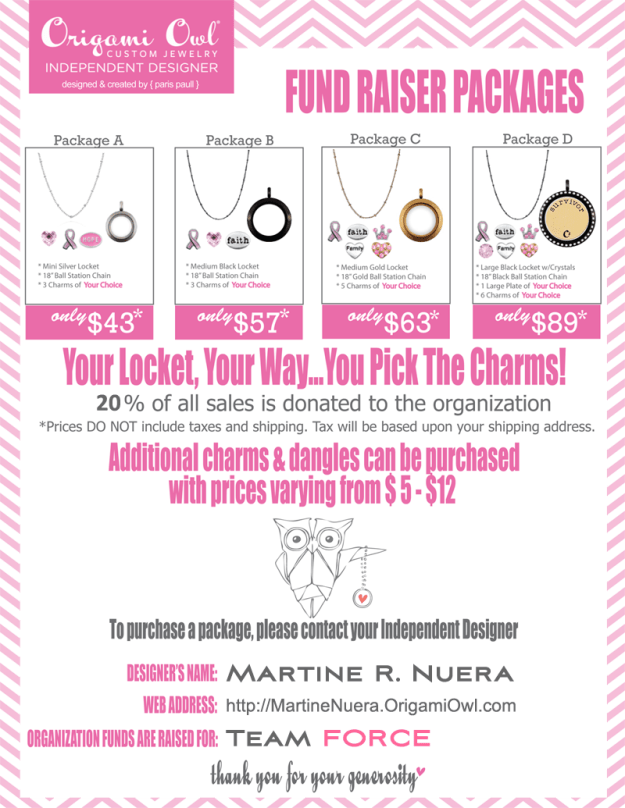
  3. Purchase some beautiful Origami Owl jewelry for yourself or as a gift. The Holiday season is just around the corner! 20% of sales go to FORCE. There are four pre-designed breast cancer related lockets (see below) or you can create your own, as I did and a few of my readers too – THANKS, LADIES!!! If you are interested in supporting FORCE and getting some great jewelry, visit our designer’s website and make sure to select Team FORCE Fundraiser at checkout: http://MartineNuera.OrigamiOwl.com.

Pre-designed lockets

Origami Owl Team FORCE

One month post-exchange

WARNING: NSFW / graphic content below.

It has been a month since my exchange surgery and over eight months since my prophylactic bilateral mastectomy. I went from about 184ccs of breast tissue pre-PBM, to 550ccs of saline in overfilled tissue expanders, to 350ccs of silicone gel in my Mentor round, smooth, high profile implants.

2013_10_5 FrontNot much has changed in the last month. I was hoping that the pocket on righty would close up a bit on the bottom, but that has not happened. This means I will most likely have a revision procedure this year to do that surgically. The new girls look fine in clothing, but I am not 100% happy when looking in the mirror. In addition to pocket revision, I am still planning on addressing the nipple asymmetry by removing the tip of the right nipple. I hope to wrap this all up by the end of this calendar year.

My scars are not pretty, but I already know I develop “two year” hypertrophic scars, so I am not surprised. I just started using Kelocote on the incision spots; hopefully this will help speed up their softening.

In other news, I just returned from a two week Europe vacation visiting Venice and my family; I’m excited to be participating in the local 2013 Race for the Cure on October 12th as part of Team FORCE (Facing Our Risk of Cancer Empowered – www.FacingOurRisk.org); and I was also recently featured in another article in the Fall 2013 edition of a local cancer magazine. Here’s my excerpt (changing names, because I want to continue to keep this blog anonymous):

“Mogatos says she never thought much about cancer until about ten years ago, when her 28-year old sister was diagnosed with breast cancer. In the intervening years, she’s had a great deal of time to think about it: she lost her sister to the disease, her mother was diagnosed with ovarian cancer, and another sister is undergoing breast biopsy.

Mogatos began having alternating ultrasounds and mammograms every six months to monitor her own breast health. She also had the BRCA test, which was negative. Once in a while she’d have an MRI, just to make sure everything was OK. Her doctor explained some women with breast cancer in their families choose to have a mastectomy, so she knew that was an option. But she was only in her early 20s, and “I was going along the lines of if it ain’t broke, don’t fix it,” she says.

In March of 2012, the time came to fix it. Mogatos picks up the story: “An ultrasound spotted some issues. Three separate masses were present. They had developed in the six months since the last mammogram. The oncologist recommended an MRI screening. Waiting for test results was hell, but when they eventually arrived, they were good – no cancer.

“In June, I felt something unusual during one of my monthly self-exams. The lump was in one of the three spots where the ultrasound found issues.” Another ultrasound confirmed that two of the three spots had increased in size and were now palpable. Mogatos had biopsies done, and again endured the terrible wait for results. There were some abnormal cells but no frank cancer. She was told to continue her self-exams and keep regular screening appointments. “The inconsistency of the messages I was getting was very hard psychologically,” she says. “I didn’t want to go through this again, having to wait for test results, feeling anxiety, then being relieved, and then ‘oops, maybe we made a mistake.’ I just couldn’t go through that again.” She began considering preventive mastectomy.

She was referred to Dr. M. “When I met him, we really clicked,” Mogatos says. “He brought up things no other surgeon mentioned. I talked to some of his other patients. I felt he’d be a great partner to get me through it.”

When the time came for surgery, she was ready. “I’d researched, I’d read, and I knew what to expect.” She was too lean for the DIEP procedure, so Dr. M placed tissue expanders, and a recent surgery replaced those with Cohesive Gel implants. “I’m ready to be done with the reconstruction,” she says. “It’s been sometimes painful, sometimes frustrating, but I’m so happy I did it. When I look at the big picture, the possibility of getting breast cancer and not making it through, like my sister, I have no regrets. It’s totally worth it. I never have to think about breast cancer again.”

BRCA mutations made simple

As many of you already know, although breast and ovarian cancer are prevalent in my family, those of us that have been tested are not carriers of any known BRCA mutations. I had blood drawn for the BRACAnalysis as well as the BART and no mutations have been found. This doesn’t mean that there is not a mutation in my family, however. It is possible that a BRCA mutation hasn’t yet been identified or it exists on another gene, such as TP53 or PTEN.

To me, genetics is a fascinating topic. So much so that I started my college education majoring in it! I love information and love learning about what really makes us tick and what doesn’t. To get a good grasp of what BRCA mutations really mean, you could do tons of research online, in a library, or by harassing your genetics counselor, OR you could just read this really awesome post written by Teri Smieja, posted on Andrea’s blog: BraveBosom.com.

BRCA mutations made simple

“A good way to think of it is this:  You have an instruction manual for making a car (the instruction manual represents the DNA). The car represents the protein. The instructions for making the engine (the most important part of the car) might be on the last page – say page 9663 – of the instruction manual (this could translate to a mutation BRCA2 9663delGT).  If that part of the manual is deleted, then the engine will never be made and the car will never run. Thus, a deletion on the last page of the manual could be just as harmful as an earlier mutation (say, one that ruined the rest of the manual, or one that deleted instructions for the wheels).”

Make sure you stop by Andrea’s blog and read the full BRCA Mutations Made Simple post.

Scar and surgery photos

WARNING: NSFW / graphic content below.

Had another follow up appointment on Friday. Dr. M refreshed the tape that’s holding up my right foob. We are going to keep doing this for a few more weeks in hopes that it will be enough for the scar tissue to form at the bottom of the pocket and close it up, BUT I may need another surgery anyway. We compared the two sides size-wise and found that we may need to swap out my right implant for a larger one. Plus, I still need to do something about this missing nipple, so yes, more OR time in my future.

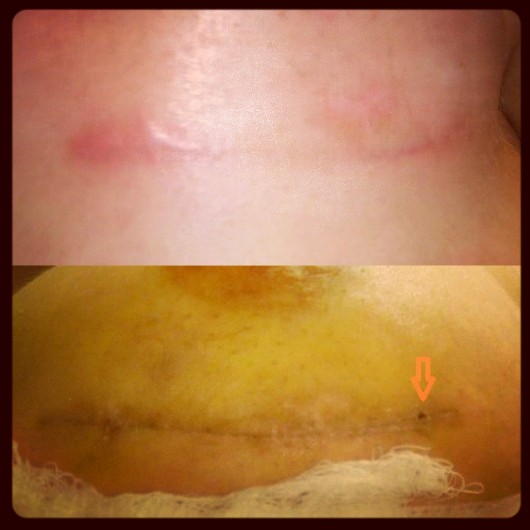
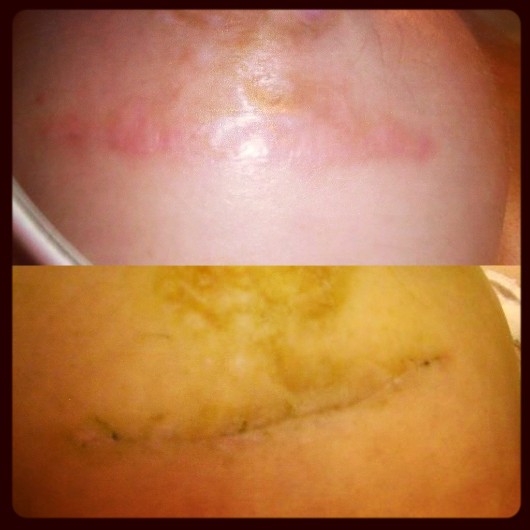
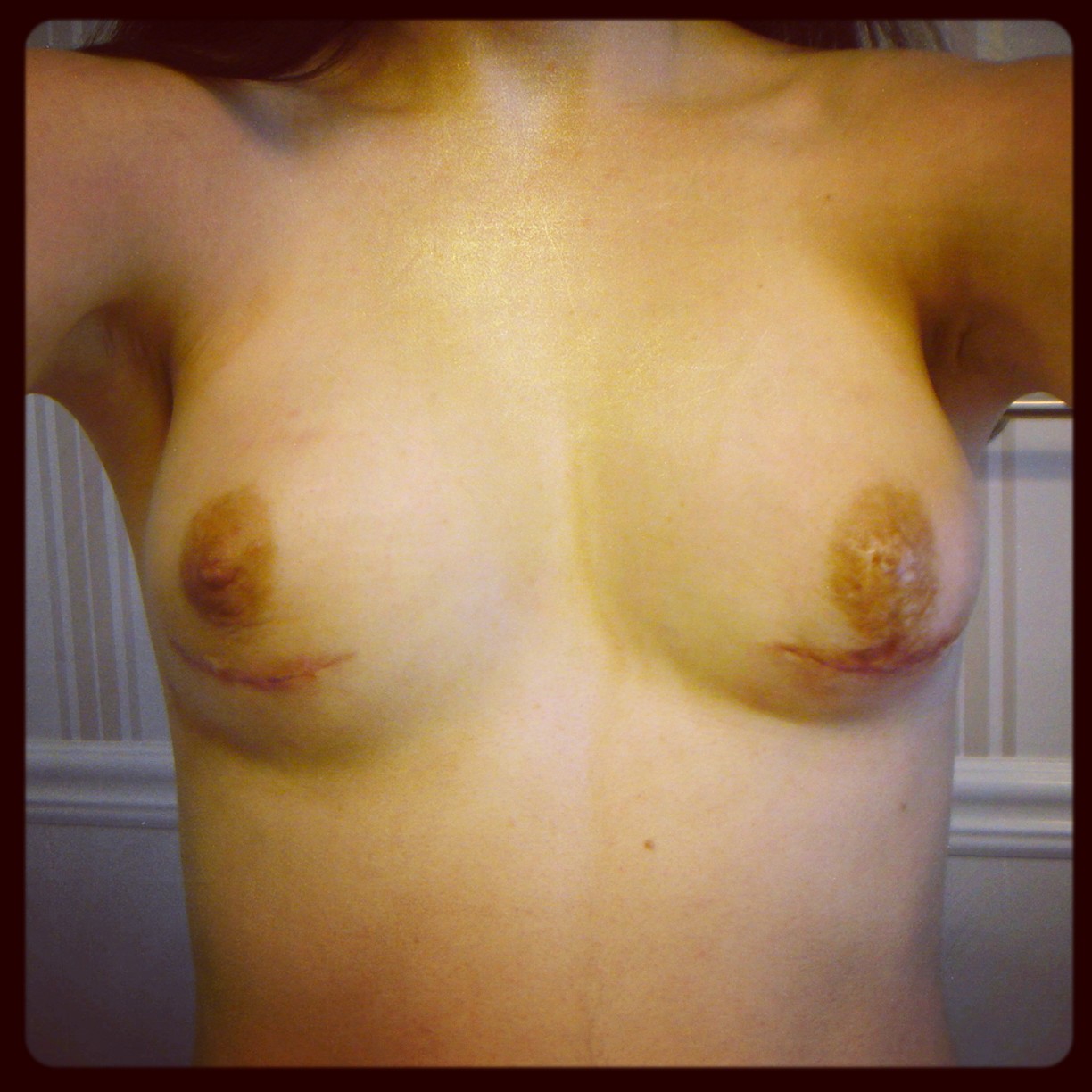
He removed the strips covering my incisions, so I can now inspect them closely. They look 3049813476 times better than after the PBM. No necrosis in sight! I have a spot that looks a little bit like the start of a stitch abscess, so I will be watching it. Here’s what my scars looked like pre-exchange and what they look like now, 12 days post-op. Different lighting, but you can see that at the bottom that they are no longer angry red and keloid-ish.

Scars on righty   Scars on lefty

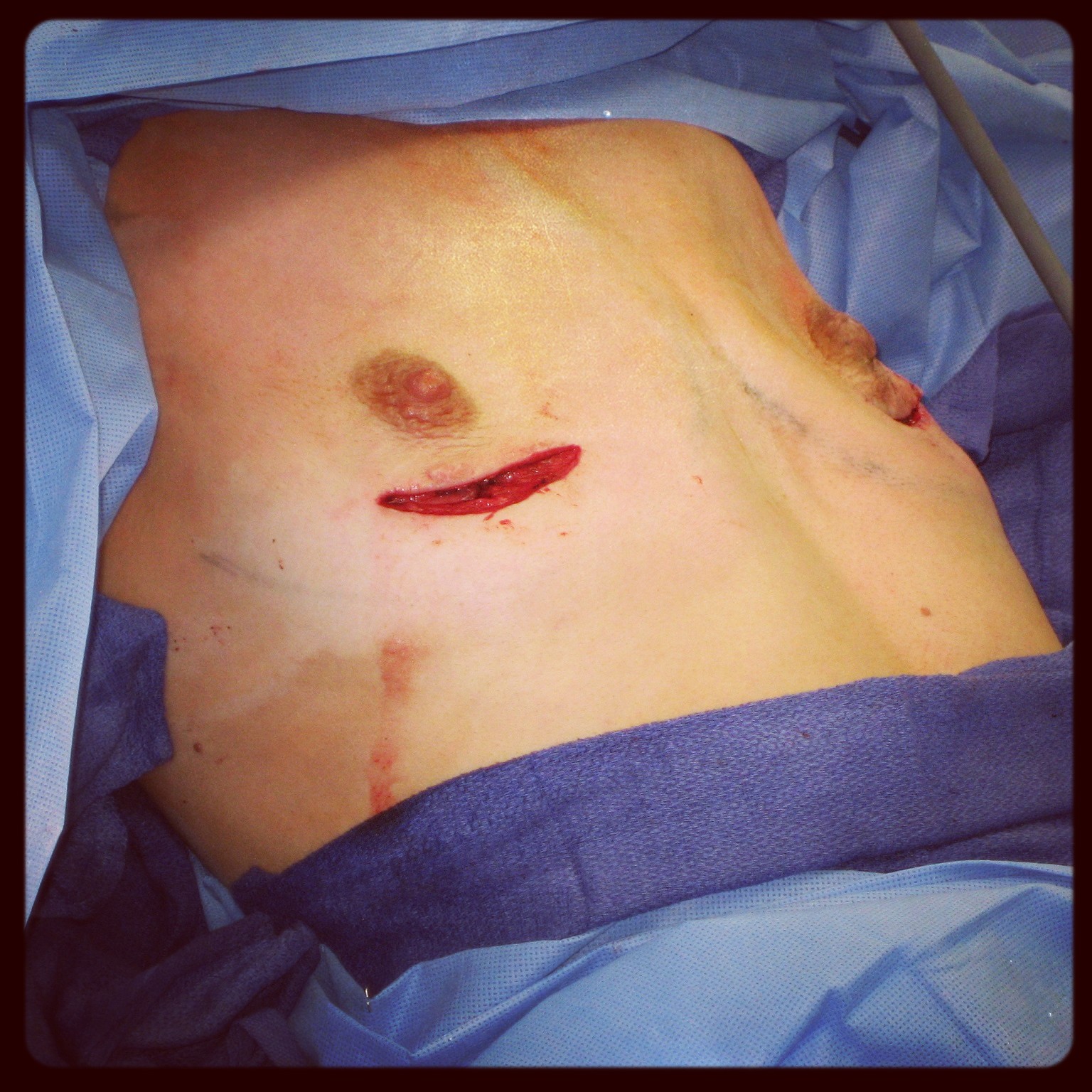
I also got a copy of my surgery pictures! It is really cool to see the changes from this angle. From left: 1. 184 g/ccs removed during PBM surgery (1/22/2013), 2. Expanders at exchange (9/3/2013), 3. One out, one to go, 4. Mentor round, smooth, high profile silicones in 350ccs.

PBM  Exchange 2 expanders  Exchange 1 expander  Exchange implants

So I think this is why my right foob seems smaller than the left one, even though the implant size is the same at 350ccs: I am concave/the hole in my chest is deeper on this side, so the implant sinks into the cavity more. We can’t do anything about it right this moment, though.

Concave front view   Concave side view

Facebook support groups

Prophylactic Mastectomy FB group

I have been preaching for a long time now that finding a support group is really essential and this is the #1 item on my list of Resources. Have you joined one yet?

Where? How?

In addition to local community groups that meet in-person, you can find support groups online, specifically Facebook. They have been created and are managed by and for women who are considering mastectomy, preparing for one, or have already been there done that and are there to support those that haven’t (other topics related to hereditary breast and ovarian cancer are also frequently discussed; this varies by group).

I joined a few of them a couple of months pre-PBM and they were and continue to be invaluable resources for me. Lots of advice, photos, love, support, and just general sisterhood. Here are a few of them:

Bonus: if you write a relevant blog, join us in the Breast Cancer & Previvor Blogs group.

These are all closed/private groups, which means you cannot see the posted content unless you are a member. If you’d like to join one, find the group (follow my link or search on FB) and click on the Join Group button in the top right corner of the group page. A few of them require the requesting person to friend one of the administrators and complete a questionnaire before they can participate, so keep an eye on your FB inbox (including the “Other” inbox).

Come on down and join us! I’m happy to assist anyone that is interested. Contact me.

“I can’t say it enough to all of you beautiful ladies, but thank you :). When I had my PBM, I did it with the support of very few people. I have struggled more than I thought I ever would and then about 3 weeks after surgery I found this group. I had no idea that there were such wonderful women that have gone and are going through the same struggles as me. I know no matter what happens I have a huge group of the most caring, strong, and wonderful women that have my back and will always be there for me. I am beyond blessed to be part of this group. I never thought at this stage of my life that I would make such wonderful new lifelong friends. So I just want you all to know I appreciate you all xoxoxo” – posted in the Prophylactic Mastectomy group (sharing with author’s permission)

Exchange surgery aftermath

WARNING: NSFW / graphic content below.

Easy peasyIt has been five days since the exchange surgery that swapped out my rock-hard tissue expanders for soft and squishy silicone implants. I must say that as I was told beforehand, this surgery really was a breeze compared to the original prophylactic bilateral mastectomy I underwent in January.
My husband took the day of surgery (Tuesday) off from work, but I was home alone the next day and onward. I spent the majority of that day napping, but was pretty mobile while awake. As I already mentioned (see: From the other side), I didn’t experience very much pain. Took my last Norco right before Wednesday’s follow up appointment, during which my drains were removed. This time around it hurt like a b#%$@! I’d say around an 8.Pain Scale

The second follow up appointment was on Friday. This is the day I started driving. During my appointment I got my handy dandy medical device ID card. I’m flying internationally in two weeks, so I’ll make sure to have it with me, but I hope I never have to use this thing.

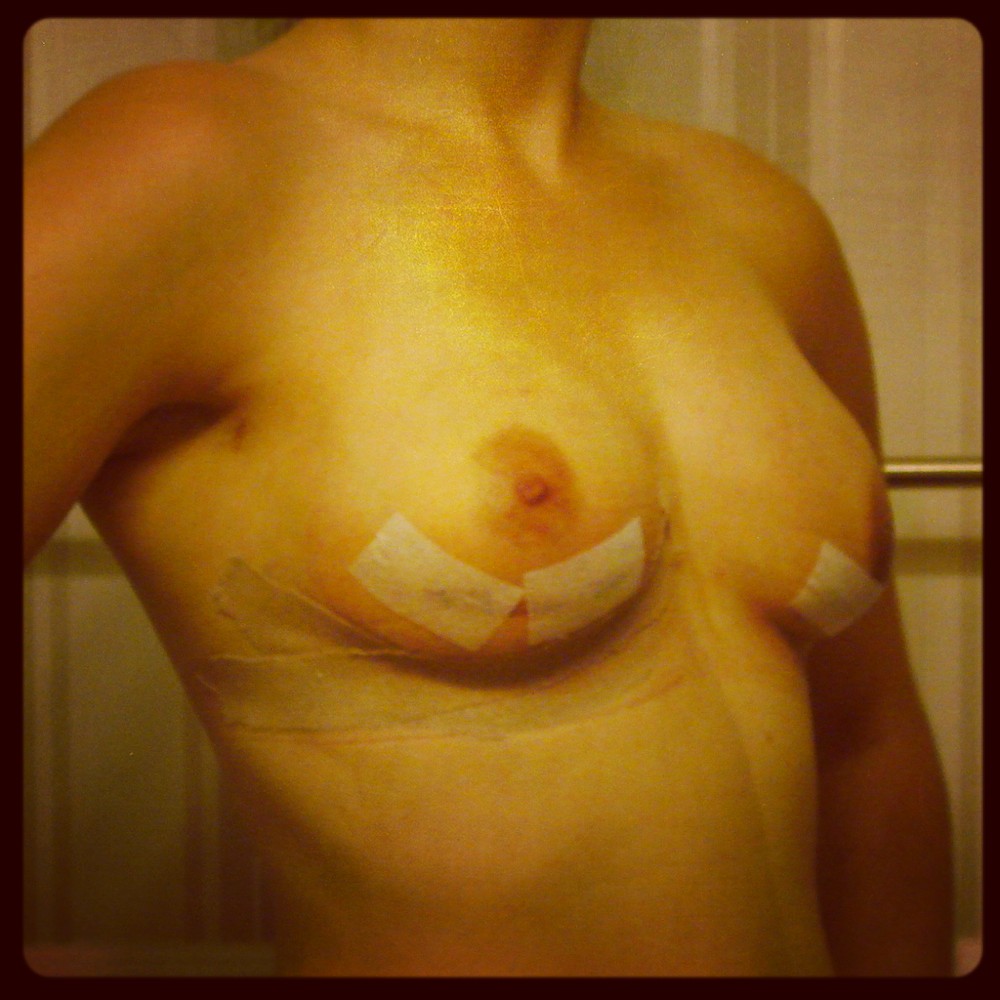
Kinesio tapeDr. M removed the ACE bandage and bra to examine the girls. He agreed that righty is hanging lower than lefty and used some kinesio-type tape to mold it into the proper position. I was told to continue to wear a tight bra and return on Monday morning.

Hubby was out of town the whole weekend, so I spent it home alone taking it easy. I had to keep reminding myself that even though I feel 100% fine, I’m not. I was wrestling with a pickle jar earlier and finally thought: these pickles are good, but a complication-free recovery is better and had my veggie burger sans pickles. It was still yummy.