Tag Archives: Plastic surgery

Last details

  • Insurance pre-authorization: confirmed
  • Disability and FMLA forms: completed
  • Consent forms: signed
  • Pre-op instructions: received
  • Pain medications: prescribed

All that’s left to do now is to get through the items on my Preparing for surgery list, think positive, and avoid getting sick! It just got real. It’s the final countdown.

Went to see the plastic surgeon for the last pre-op appointment. We discussed a few last details:

  • QuestionsSome ladies are told not to shave, as it may increase chance of infection. Is shaving OK before the surgery? Yes, it’s fine.
  • Will I get a pain pump implanted or IV-type pain medication while at the hospital? The pain medication will be administered via IV, not a pump. Implanting the pump creates additional surgical/wound sites and isn’t necessary for this type of procedure.
  • How soon after surgery do I start follow ups? I will meet with the surgeons before leaving the hospital. If there are issues after leaving, may see the plastic surgeon every day, may not see him for a few days. Depends on how things go. Will keep in touch.
  • How soon will the first MRI need to be completed? The MRI is done two years after the implants are in, so nothing to worry about in the immediate future (especially since this will be a staged reconstruction, which means the final exchange of implants for expanders will not take place until about six months after mastectomy). These screenings will be monitored by the plastic surgeon. Breast cancer screenings will continue via clinical exams from the breast surgeon/OB-GYN/PCP.
  • Is physical therapy recommended? Not typically. Some women are back to normal fast, some take a few weeks. Try to do things without help from others (within reason). Brush your own hair the day you get back from the hospital. When you can shower, wash your hair yourself. Do some range of motion exercises. If not making progress, PT may be recommended to help with the recovery.

Added 1/19: Check out this awesome video from Casey EischenBS, CSCS, CPT, CES, Health/Fitness Expert and Nutrition Coach, providing levels 1 & 2 of a great exercise program for women who have undergone a prophylactic bilateral mastectomy. More to come!
Exercises to Recovery from Phophylactic Mastectomy/Reconstruction

Let’s give them a chance

The nipples … I decided to keep them.

I met with Dr. K to talk about a few things I wanted to revisit before we sealed the deal. One of them being: whether or not my mastectomy will be nipple-sparing (see Nipples, pecs, bras, OH MY!). Some of the things we talked about:

  • QuestionsHow much breast tissue (if any) will be left behind? A small disk of breast tissue remains under the nipple to prevent inversion.
  • What are the chances of breast cancer diagnosis? In the case of a prophylactic mastectomy (especially for a BRCA1/2-mutation-negative patient), the risk of developing breast cancer is still very low (<1%; see this summary table from the related article mentioned below). A long-term Georgetown study (related article #2 below) concludes that nipple-sparing mastectomy can be safe in properly selected patients.
  • What type of screening is done long-term? Screening is still required after any type of mastectomy via self and clinical exams. Mammography/ultrasounds/MRIs are generally not needed. However, screening MRIs are required when breast implants are used for reconstruction.
  • What are the chances of necrosis? From the nipple-sparing mastectomies my breast surgeon has performed, no nipples have been lost. He will make the incision laterally from the edge of the areola, versus circumareolar (tracing around it and then out). This will make the procedure technically a bit more difficult, due to a smaller access hole to the cavity, but will reduce the risk of necrosis. The article mentioned below also provides some data related to necrosis of the nipple-areola complex. 2/9: The incision that was actually made was a curved/smiley-face line about two inches below my nipple.
  • Will I have any feeling left? This is unlikely. Nipple(s) can become erect after this type of procedure, but the experience will not be the same as pre-mastectomy, both in cause and sensation.
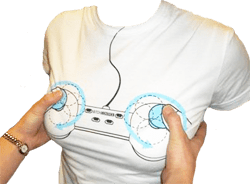
  • Nipple Game Pad T-ShirtSo will I have permanent headlights? This is a possibility. A few of the ladies I’ve spoken to have expressed that this is true for them after a nipple-sparing procedure. As you can imagine, having constantly-erect nipples can make things awkward, so definitely something I hope I don’t have to deal with. However, in discussing with my PS, I learned that as with other possible unsatisfactory results, it can be addressed in a few different ways. Worst case scenario: another procedure to remove the nipples and areolae.

I’m confident that Dr. K is technically capable of performing this type of procedure and will do a great job. I am aware of the potential complications (not all listed here) – we’ll cross that bridge if we get to it.

Whew, that was the last thing to mull over, last detail to plan, last thing on my list that’s up to me (well, this list). Now the breast surgeon’s office confirms the insurance pre-authorization and I sign the consent forms. One pre-op appointment left with my plastic surgeon.

Related articles:

Now what?

I made appointments for consults with the three plastic surgeons.  Not being too familiar with the procedure, I made a list of the questions that immediately popped into my head.  Then I made Google my new best friend.  After many hours online and a ton of information and photos, most of my general questions were answered.  I narrowed it down to the ones that were more specific for me (I now know the answers, so including them as well):

  • QuestionsWhich procedure would be best for me? Nipple-sparing bilateral mastectomy with two-stage breast reconstruction.
  • What are the risks for that type of procedure? Nipple or breast tissue necrosis, infections, seroma, capsular contracture – NSFW, ruptures, rippling, cosmetic issues.
  • Can I see before-and-after photos of previous patients/work?
  • What is the time frame for the whole process, from start to finish? Up to six months if there are no serious complications.
  • Which hospital?
  • What would be expected of me? Get educated, prepare self and home for recovery, focus on the positive.
  • What are the surgeon’s qualification and experience?

The point of the consults was to determine who I would like to work with if I wanted to move forward. I remember thinking “How can I decide based on a 30 minute conversation? What should I really consider?” I met with all three of the surgeons recommended. After talking it over with my husband and doing some more Googling, I decided I wanted to work with Dr. M. I based this on a bunch of different things including years of experience, the details we discussed, his demeanor, our “chemistry,” the before-and-after photos of his patients (many binders of them), and the fact that he is well known for DIEP flap reconstruction, which is very complicated and requires microsurgery, so this one should be easy, right?

I already had a breast surgeon, I just picked the plastic surgeon, now all I needed to do was to schedule it.

You’re doing WHAT?

January 22, 2013.  Seems so far away, but I know it’ll be here before I know it.  That’s the day I’m having a prophylactic bilateral mastectomy (PBM) and start the breast reconstruction process.  A PBM is an elective, preventative procedure which surgically removes breast tissue (see more details under WHAT IS A PBM?).  You’re doing what with WHAT?  Ya, I am doing it.  I have thought long and hard about what this really means.  I have discussed this with family, friends, and doctors.  I have done hours of research, almost ad nauseam.  After considering all of the factors, the risks, the benefits, the uncertainties, the consequences, I know this is the right decision for me.